Inflation in the real world
Click here to send an edit suggestion
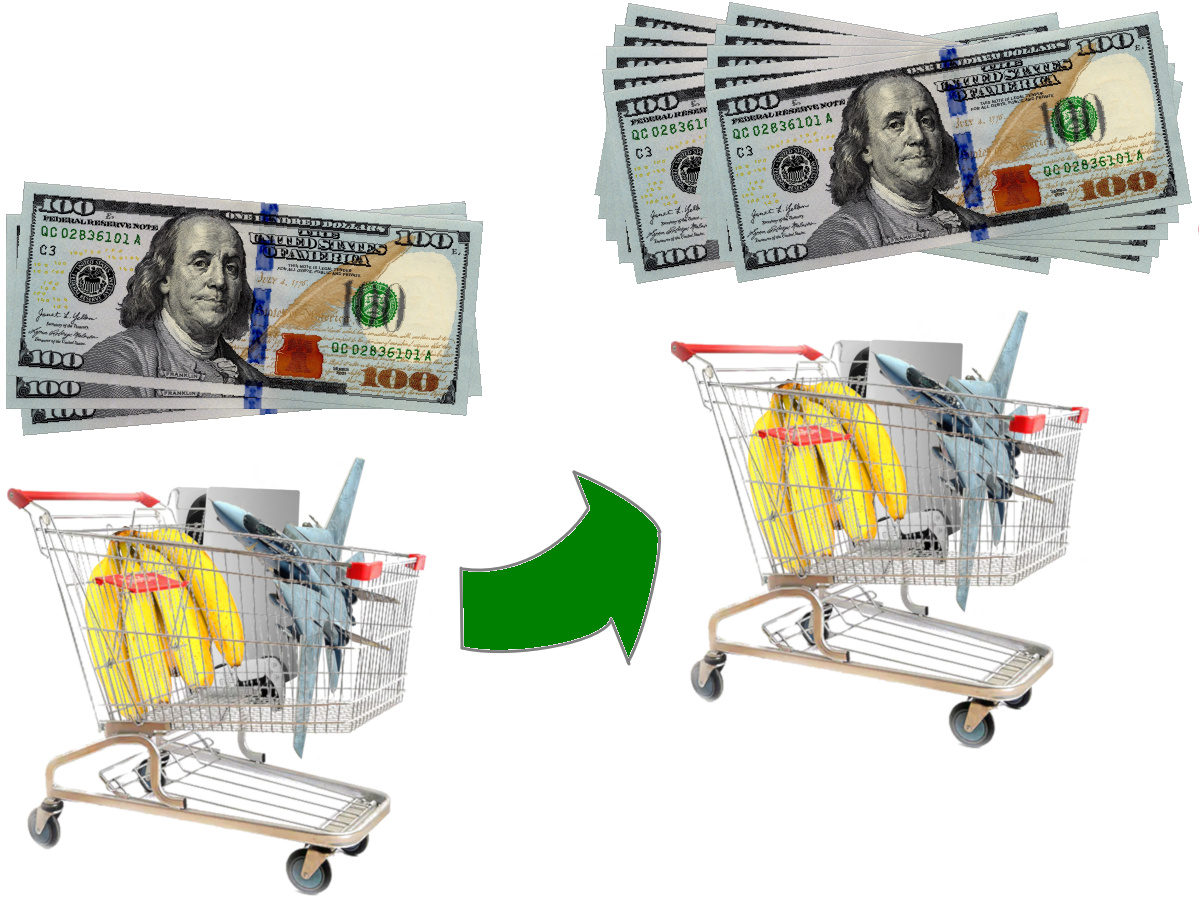
Based on kept receipts, the inflation I experienced over the last 17 years: The total grocery expenditures over a two-month period lead to inflation of 2.4%/a. Price per item increased 1.9%/a, total number of items bought increased by 9%. Of three specific items, the most inflated item almost exactly doubled in price, representing 4.2%/a, the least inflated grew its price by 0.7%/a, the third increased by 2.7%/a. Weigthed average of these 3 results in 3.0%/a.
So, you've decided to distrust everyone and consequently believe official inflation numbers are all made up? Good thing I've kept my grocery receipts from ages ago up to today. So now I can use these receipts to figure out how much actual inflation I've suffered over the last 17 years. I used a two-month period almost exactly 17 years ago and the previous two months and added all my grocery expenditures over each of these periods. That leads to a yearly inflation of 2.4%. But of course I don't buy exactly the same things now that I bought 17 years ago, so the numbers are not perfectly comparable. That's why I also counted the number of items I bought for both periods to calculate the average price per item. The price per item increased 1.9% per year, the total number of items bought increased by 9%. But since there is a bit of noise in the number of items, that won't tell you a lot. So I also picked out three specific items that haven't changed in size or composition and that I bought back then and still buy. I compared the average price (average over the 2 months) of the item 17 years ago to the average price now. The most inflated item almost exactly doubled in price, representing 4.2% per year. The least inflated grew its price by 0.7% per year. Another item increased by 2.7% per year. If I assume I buy one of each of these three items every week, then the inflation for the sum of all three is 3.0% per year.
My rent (15 years in the same apartment) increased by 2.6%/a. based on IIRC (If I remember correctly) 3 increases in total. Had the time period been different, these 3 increases could've lead to 1.4%/a - 4.0%/a. Electricity appreciated 1.9%/a over 10 years, but the worst short-term spike would've resulted in >6%/a.
Groceries make up only part of my expenditures, so what about the rest? Unfortunately the rest can't be compared all that easily. I have data on my rent, but rent doesn't increase smoothly and it's not an average over multiple items and so any inflation data derived from that will be noisy and not very representative of other people's rent. But I've lived in my current apartment for over 15 years and thus the rent increases are at least averaged over a longer time period. Based on my data, rent increased by 2.6% per year on average. IIRC (If I remember correctly) there were 3 increases in total over that period and if the time period had been different, a very favorable or unfavorable placement of the dates of rent increases could have resulted in values between 1.4% per year and 4.0% per year. Electricity prices are also very variable and thus not a reliable inflation indicator over the short term, but here are my numbers anyway: 1.9% average per year over 10 years, but the worst spike during that timeframe would have resulted in >6% per year, because the price exploded in one year (due to a certain war in Europe) and then went down again.
Cold water went up 2.7%/a over 10 years. Water heating stayed constant, but apartment heating cost increased by 4.5%/a. All data from a city in western Europe.
Cold water went up 2.7% per year over 10 years. Cost for heating the water stayed essentially constant over the same time period, but the cost for heating my apartment increased by 4.5% per year. The cost increase should have been caused by an increase in gas price, but I don't have good data for that. I also don't have useful data about the price increase for Internet/phone connection, healthcare or transportation. Data for my total expenses is also not useful, as they have fluctuated. But the total is dominated by rent and so the inflation of the total should be close to that of rent.
This is all based on living in a city in western Europe.
Click here to send an edit suggestion
Written by the author; Date 21.01.2026; Updated 06.03.2026; © 2026 spinningsphinx.com
- Mocking
- Sarcasm, e.g. "Homeopathy fans are a really well-educated bunch"
- Statement not to be taken literally, e.g. "There is a trillion reasons not to go there"
- Non-serious/joking statement, e.g. "I'm a meat popsicle"
- Personal opinion, e.g. "I think Alex Jones is an asshole"
- Personal taste, e.g. "I like Star Trek"
- If I remember correctly
- Hypothesis/hypothetical speech, e.g. "Assuming homo oeconomicus, advertisement doesn't work"
- Unsure, e.g. "The universe might be infinite"
- 2 or more synonyms (i.e. not alternatives), e.g. "aubergine or eggplant"
- 2 or more alternatives (i.e. not synonyms), e.g. "left or right"
- A proper name, e.g. "Rome"