Two notions of optimality
Click here to send an edit suggestion
The usual notion that both players play optimally should be augmented by a new notion of optimality called "strongest resistance" that is used to clearly and consistently distinguish optimal moves from Hamete in all cases. The usual notion that both players play optimally should be augmented by a new notion of optimality called "strongest resistance" that is used to clearly and consistently distinguish optimal moves from Hamete in all cases.The notion of optimality usually used is that both players play optimally at all times and thus all sub-optimal lines can be ignored as they don't change the value of optimal lines. In reality, players do make mistakes and any analysis that takes this into account could use a second notion of optimality, which I would call "strongest resistance". This notion of optimality would try to choose moves that might be sub-optimal according to the usual notion of optimality, but are difficult to refute and thus might offer a chance to catch up when behind by a lot. The usual notion of optimality can not help in this case, because catching up is impossible if both players always play optimally. In Jouseki databases, such "strongest resistance" lines are usually called Hamete (sometimes "overplays" ), but are not always and not consistently marked as such. In Tsumego, "strongest resistance" lines are usually shown when the topic is life/death, while optimal lines usually show up in endgame Tsumego. But once again, both types of lines do not show up always and are not consistently distinguished from each other.
One could easily find more notions of optimality. E.g. a "defensive" optimality, the mirror image to "strongest resistance", that tries to avoid all complications when far ahead and is willing to lose points to achieve that goal. Or using the number of Kou threats for the opponent left behind after a move, which can distinguish between different moves that otherwise appear equally optimal. Or the complexity of a move, which is hard to define, but is related to "strongest resistance", because Hamete lines are not just sub-optimal, they are sub-optimal and complicated (lines that are sub-optimal and simple are just stupid, not Hamete). And finally, in the endgame the "temperature" can sometimes distinguish between apparently equally optimal moves.
When analyzing Go games, building opening collections, designing Tsumego and so on, Go players usually apply a notion of optimality, which is the basis for all assumptions during analysis. That notion is that both players should play optimally and that sub-optimal lines can be ignored, because they have no influence on the value of the optimal lines. This idea makes sense intuitively, because both players want to win and playing sub-optimally is not the right strategy for winning. If both players want to win, then obviously both should apply this thinking and this notion of optimality should be applicable in all Go positions.
Unfortunately, reality is more complicated than that. In reality, no human plays optimally all the time and thus recognizing the potential for mistakes in both your opponent's play and your play should be part of your analysis. Looking at analysis of Go positions under this more realistic assumption should justify using at least 2 different notions of optimality (possibly more) , which often lead to different "best" lines. The first notion is just the normal assumption of constant optimality for both players. The second notion is what I would call "strongest resistance" and assumes a certain probability of mistakes (even gigantic mistakes) for every move of the opponent. These two notions lead to different results if the current player is significantly behind or is assumed to be significantly behind (e.g. the white player in a high handicap game) .
If the current player X is far behind, then the usual notion of optimality leads to hopeless variations that all end with player X still being far behind, because optimal play for both players of course means that X's opponent does not just lose points. The rational conclusion under that assumption is to just resign to save time and energy for the next game. But the "strongest resistance" notion would instead focus on lines that give X's opponent the greatest chance for blundering away the advantage, i.e. complicated and long lines. Many of these lines would lead to an even worse loss if X's opponent makes no mistakes, but that is irrelevant, as a lost game is a lost game, no matter by how many points the game was lost. But this potential for coming out even worse than before is why the usual notion of optimality avoids these risky lines.
So far, this should all appear pretty obvious, so what's the point? The point is that I almost never see this distinction made clear in Jouseki databases or Tsumego solutions. There, both lines created under the usual optimality notion and "strongest resistance" lines are presented side by side as equivalent, or even worse, either optimal lines or "strongest resistance" lines are left out entirely, as if they don't exist. I think that this lack of distinction creates a misunderstanding and bad play. If you only learn how to mount a futile attack against a living group (i.e. a "strongest resistance" line) , you might never learn how to play against this group optimally. An example:
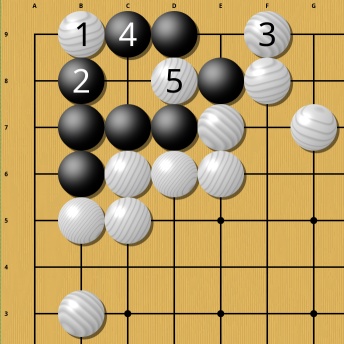
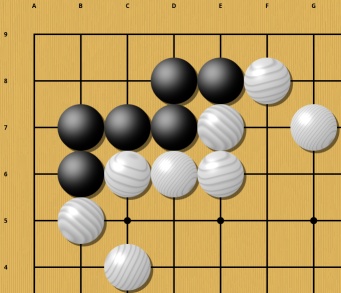
The first group can't be killed, and so Tsumego might focus on the many ways to attack and defend this group. But optimal endgame play is to throw in a stone as if mounting an attack and then sacrificing this stone again. Tsumego focused on "strongest resistance" lines might ignore this as an uninteresting, easy to deflect attack, but in my opinion good Tsumego should include the line and clearly distinguish it from all the lines containing failed attacks. This is particularly relevant here, because in the second example no such endgame trick is possible. Of course, the absence of some lines is usually caused by the fact that Tsumego are composed with a specific topic in mind, and so life/death Tsumego would only contain the "strongest resistance" lines and endgame Tsumego would only contain the endgame line. That is good for reducing Tsumego to the bare minimum, but I think it's bad for a holistic view of the game.
More relevant examples might be found in Jouseki, where tricky sub-optimal lines are usually called Hamete ("overplay" is a closely related term) , but are quite often left out completely as examples of bad play (My favorite Jouseki database leaves out all Hamete lines, because the data are extracted from professional games and professionals obviously know and avoid Hamete lines due to their sub-optimality) . The problem caused by the lack of Hamete lines is that once you encounter them in actual play, you might not know how to refute them, because your Jouseki source left them out. If they are present, some Hamete are marked as such, but it's not consistent. The ideal Jouseki source for me would include all Hamete, but would also clearly and consistently mark them as such and give you the option of just not displaying them, if a less cluttered view is desired.
If you've ever used or developed a Monte Carlo tree search Go engine, the distinction between optimal and "strongest resistance" play should feel very natural to you. MCTS engines are famous for changing their play style strongly when either far ahead or far behind. Pure MCTS engines play implausibly aggressive and crazy moves when behind, because their winning-probability-focused view of the game tells them that only provoking a mistake can turn the game around. Even engines like Katago that take the points difference, not just winning percentage, into account, choose different lines when behind.
I said there are at least two notions of optimality. Are there more? Yes. You could easily include additional lines based on a "defensive" notion of optimality that tries to achieve the opposite of the "strongest resistance" notion: Instead of trying to catch up from behind, it would try to solidify a sizable advantage by choosing lines that offer little chance for complication, but potentially give points away. In fact, each points difference offers its own notion of optimality. Being 10 points ahead would prefer different lines than being 5 points ahead, because with 10 points advantage, even a 9 points sacrifice can be playable, but when only 5 points ahead, such a line would have to be excluded. Apart from varying notions of optimality based on advantage/disadvantage, one could also take Kou threats into account to find distinctions between different lines that appear equally optimal under a superficial analysis. That is also rarely done in Tsumego explicitly. Occasionally additional Kou threats are mentioned, but once again it's not consistent. If it's not clear what distinction is meant, an example:
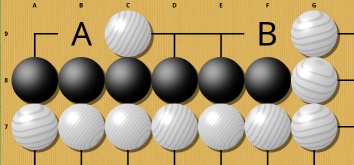
Both options A and B save the black group, but B gives white a Kou threat, whereas after playing A, White has no threats against the black group. Of course in this example, A is sub-optimal from an end game point of view, but it's probably easy to construct an example where two moves that appear equally optimal differ only in the number of Kou threats they leave behind.
Another distinction that seemingly has no connection to optimality is the difficulty of a move. Two different moves can be equally optimal (i.e. neither is Hamete) , but one leads to much more complicated variations. The connection to optimality is that difficulty of course influences the winning probability and so a player with a disadvantage would like to choose the complicated variation and an advantaged player would like to choose the simple variation. The problem here is that difficulty is hard to estimate as it depends on the individual player. The AI notion of difficulty is not really applicable to humans and thus can't be used. Because difficulty is so hard to estimate, I'm willing to tolerate this particular lack of distinction for the time being, but I hope that in the distant future we'll find a way to make this distinction explicit as well. Of course difficulty is related to "strongest resistance": Hamete lines are not chosen because of their sub-optimality, but because their sub-optimality is partially compensated by the complexity they offer. Without that complexity, every idiotic move could be called Hamete.
And finally, in the endgame, the "temperature" might be important. The temperature is the size of the largest play elsewhere (not in the currently considered position) on the board, i.e. the value of Tenuki, i.e. the value of Sente. In some endgame positions, the best move at temperature 20 might be different from the best move at temperature 2 and thus the temperature can serve as another distinction between different notions of optimality.
Distinguishing moves based on what kind of notion of optimality is used can be done by using different colors for different moves. josekipedia.com already does that for Hamete, but most Tsumego do not. An alternative that is better for colorblind users would be lowercase letters and uppercase letters. Using a button to switch back and forth between "optimal" and "strongest resistance" is another way to handle it, but that would obviously not work in printed material. My own Jouseki database tries to distinguish between 4 notions of optimality via buttons for switching between these notions. I haven't mentioned these 4 notions yet, because they don't fit neatly into anything I have described above. Take a look at the Jouseki database for more details.
PS: I eventually remembered that the notion of difficulty of a line is of course related to the amount of thinking time required to navigate that line. And that makes it clearer why managing difficulty is an important part of selecting optimal lines: To win, you need to have more points than the opponent and also not run out of time. Time is thus just as important a resource to manage as your points. The usual notions of optimality only care about your points, but a holistic view would take both points and time into account and would be willing to exchange one for the other. Of course estimating the time required for navigating some line is difficult. But, using Katago and a lot of human training data, I think it should be possible to predict which move sequences humans typically find difficult to play (assuming the line hasn't been memorized, of course).
Click here to send an edit suggestion
Written by the author; Date 07.02.2026; Updated 18.07.2026; © 2026 spinningsphinx.com
Written by the author; Date 07.02.2026; Updated 18.07.2026; © 2026 spinningsphinx.com
Written by the author; Date 07.02.2026; Updated 18.07.2026; © 2026 spinningsphinx.com
Written by the author; Date 07.02.2026; Updated 18.07.2026; © 2026 spinningsphinx.com
- Mocking
- Sarcasm, e.g. "Homeopathy fans are a really well-educated bunch"
- Statement not to be taken literally, e.g. "There is a trillion reasons not to go there"
- Non-serious/joking statement, e.g. "I'm a meat popsicle"
- Personal opinion, e.g. "I think Alex Jones is an asshole"
- Personal taste, e.g. "I like Star Trek"
- If I remember correctly
- Hypothesis/hypothetical speech, e.g. "Assuming homo oeconomicus, advertisement doesn't work"
- Unsure, e.g. "The universe might be infinite"
- 2 or more synonyms (i.e. not alternatives), e.g. "aubergine or eggplant"
- 2 or more alternatives (i.e. not synonyms), e.g. "left or right"
- A proper name, e.g. "Rome"