When does the center become valuable?
If you ever wanted to know how much a move in the center is worth if the center is surrounded by strong groups of both players, I created artificial positions like that, analyzed them with Katago and got results ranging from 2 (for walls 3 empty places apart) to 8 points (for wall distance 13) in Gote.
Have you ever had positions like the following and wondered whether making moves in the center is valuable and how valuable exactly?
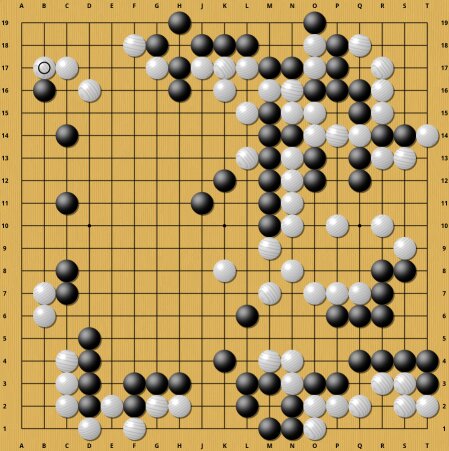
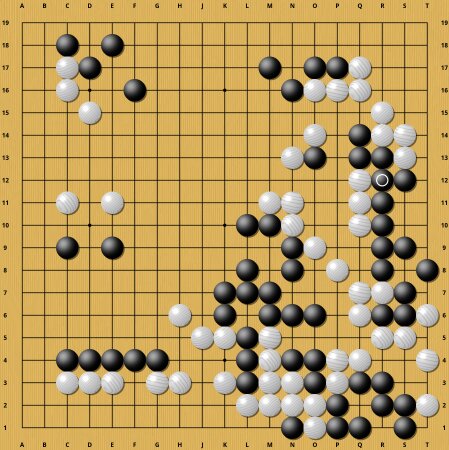
I made simplified positions like the following and analyzed them with Katago.
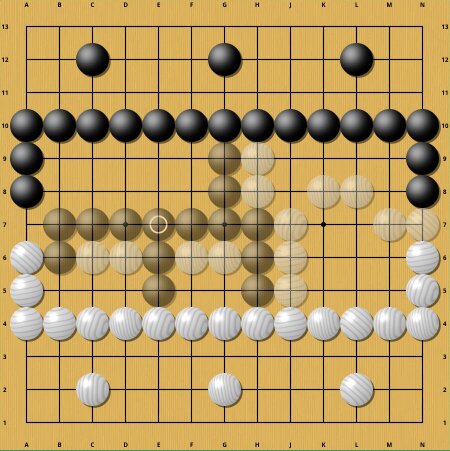
The conclusion: If the walls are 1 or 2 empty places apart, the entire area is neutral. For 3 or 4 places distance, the best moves make only 2 points in Gote. For 5 places distance, 4 points. For 6 or 7 places distance, 6 points. Making the board wider doesn't change that. Even the largest position I created, with 13 places distance, seems to allow only for 8 points in Gote.
What about positions with 4 groups looking at the center, 2 white and 2 black groups? The value seems to be even lower, from 2 (for a diamond-shaped center) to 4 (for a square center) points in Gote.
Have you ever had positions like the following and wondered whether making moves in the center is valuable and how valuable exactly?
I made the following simplified positions and analyzed them with Katago. Even without showing any specific move sequences, the value of the best moves can be determined by just letting Katago estimate the current score and then letting it estimate the score again after passing. The difference between these two values is approximately the value of Sente.
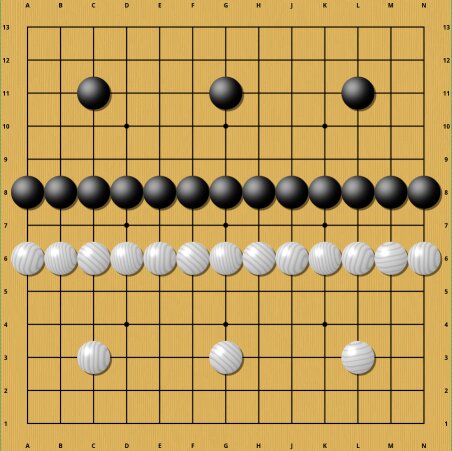
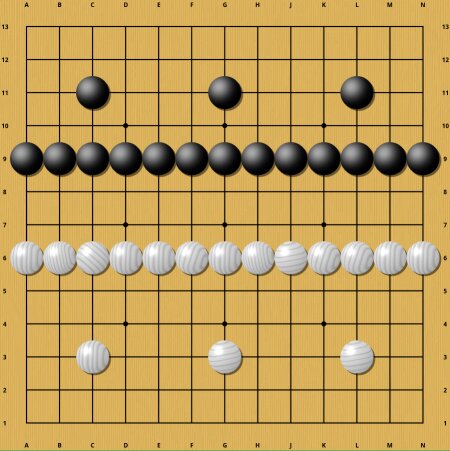
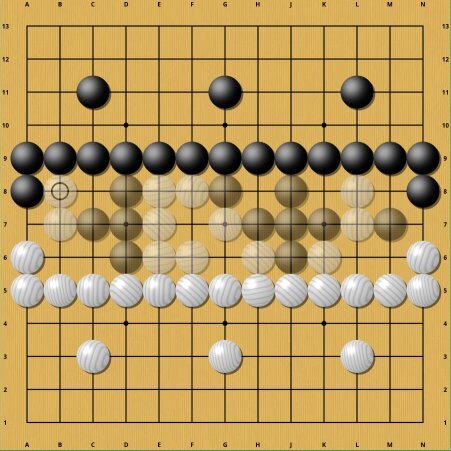
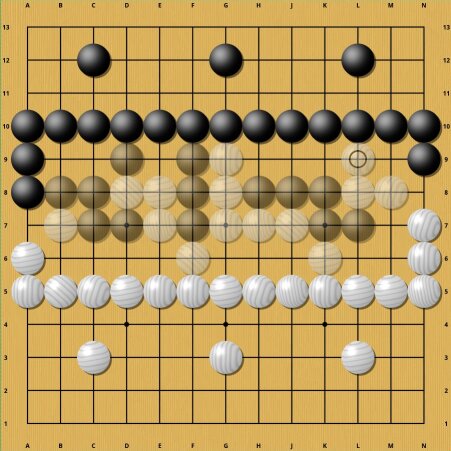
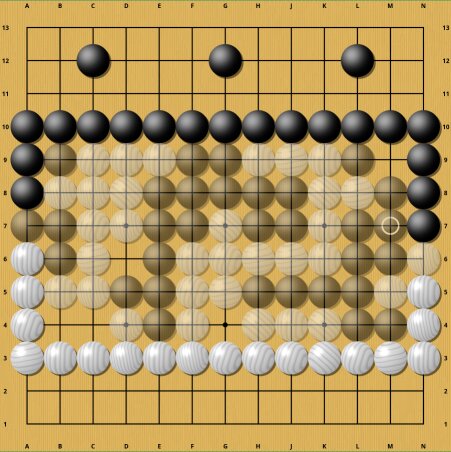
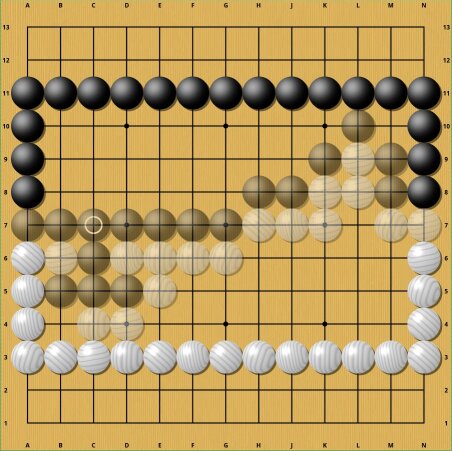
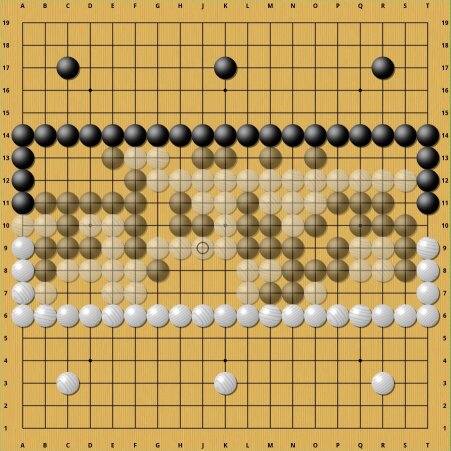
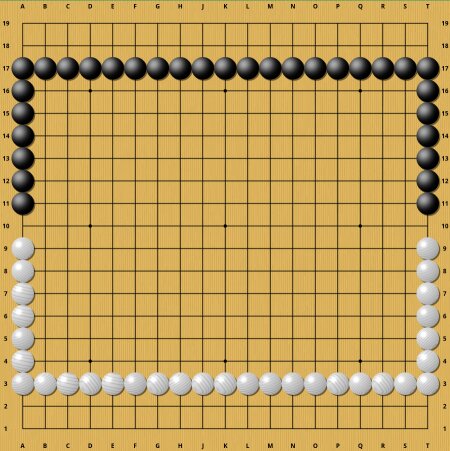
The conclusion: If the walls are 1 or 2 empty places apart, the entire area is neutral. For 3 or 4 places distance, the best moves make only 2 points in Gote. For 5 places distance, 4 points. For 6 or 7 places distance, 6 points. Making the board wider doesn't change that. Even the largest position I created, with 13 places distance, seems to allow only for 8 points in Gote.
What about positions with 4 groups looking at the center, 2 white and 2 black groups? The value seems to be even lower, from 2 (for the diamond-shaped center) to 4 (for the square center) points in Gote.
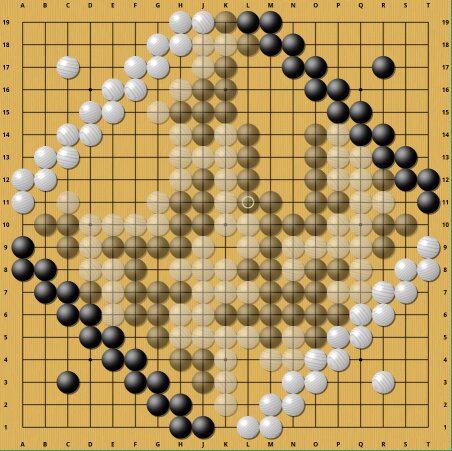
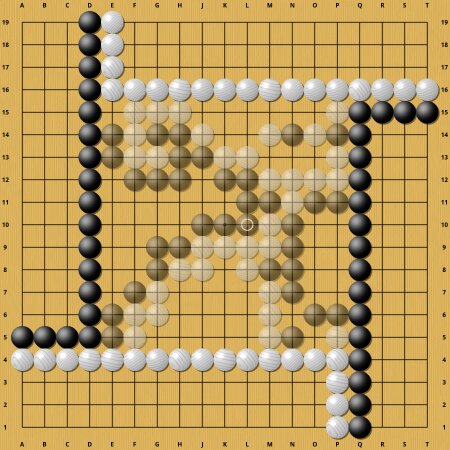
I noticed that in the case of a diamond-shaped center where the bordering groups are not yet fully connected, the value of the center move increases from 2 to 12 points in Gote. That is a clear indication that the strength of the groups surrounding the center is quite important for determining the value. The weaker the groups, the higher the value of the center move should be, because it can strengthen those groups.
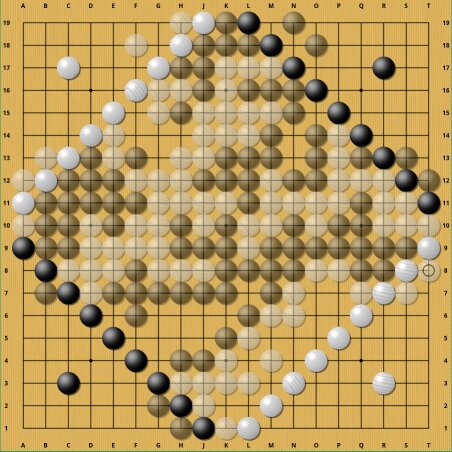
Unfortunately that statement can't be generalized arbitrarily. I also analyzed a weaker version of the square center and got a value of just 2 points in Gote. But in this case, Katago changed its mind so often during calculation that I'm unsure whether the result is accurate.
Have you ever had positions like the following and wondered whether making moves in the center is valuable and how valuable exactly?
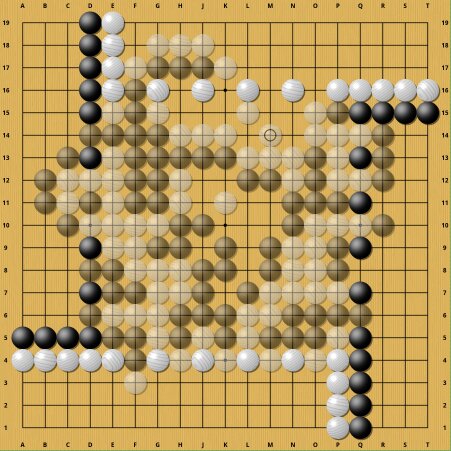
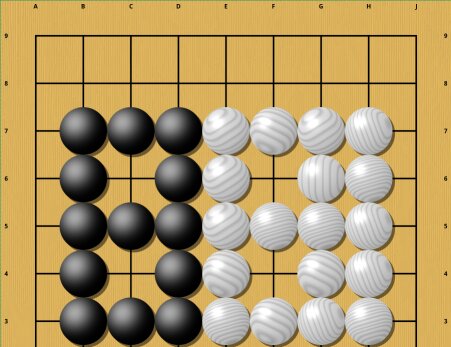
I have, too, and so I made the following simplified positions and analyzed them with Katago. In all positions, the center is the only area where potentially valuable moves can still be made, the edges have been closed off to reduce edge effects, all existing groups are completely safe and strong (to make sure this is a pure endgame question) and are facing each other. Obviously if the groups are almost touching, the entire area is neutral, i.e. dame. But you have probably made the discovery in some of your games that making territory in the center is really hard unless you already have strong groups on multiple sides, leading to the suspicion that maybe the center is always neutral if there are both black and white groups surrounding it and those groups are safe. After all, most players know that you need 4 walls in the center to enclose territory, in contrast to 3 walls on the side and 2 in the corner. Even without showing any specific move sequences, the value of the best moves can be determined by just letting Katago estimate the current score and then letting it estimate the score again after passing. The difference between these two values is approximately the value of Sente.
The conclusion: If the walls are 1 or 2 empty places apart, the entire area is neutral, i.e. all moves are worth 0 points. For 3 or 4 places distance, the best moves make only 2 points in Gote, i.e. like the position on the left. For 5 places distance, the best moves make 4 points in Gote. For 6 or 7 places distance, 6 points in Gote, like the position on the right. Making the board wider doesn't change that. That shouldn't be surprising: The position is symmetric, there is only one first move and the influence of that move is restricted to its immediate vicinity, just like Komi doesn't change much for larger board sizes. Even the largest position I created, with 13 places distance, seems to allow only for 8 points in Gote. Maybe more valuable centers can be created on larger boards, but unfortunately my Katago version only supports boards up to 19x19. During this analysis, I also discovered that Katago significantly misestimates the size of these moves. It estimates 12 points in Gote in an initial position that produces a sequence which yields only 8 points in the end.
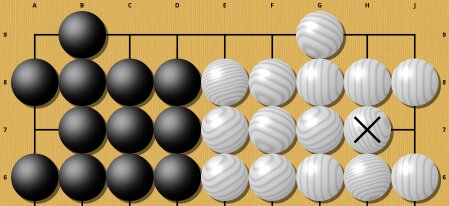
What about positions with 4 groups looking at the center, 2 white and 2 black groups? The value seems to be even lower, from 2 (for the diamond-shaped center) to 4 (for the square center) points in Gote. In these cases as well Katago initially overestimates the value.
But while testing out various positions, I noticed that in the case of a diamond-shaped center where the bordering groups are not yet fully connected, the value of the center move increases from 2 to 12 points in Gote. That is probably because creating additional territory saves you a lot of reinforcing moves that you would otherwise have to make in these bordering groups. That is a clear indication that the strength of the groups surrounding the center is quite important for determining the value. The weaker the groups, the higher the value of the center move should be, because it can strengthen those groups. Interestingly, in the case of the weaker groups, Katago initially underestimated the value of the move. In fact, it seems like Katago completely ignored the strength of the groups when makings its initial estimate. I assume this is related to the fact that Katago never saw such positions during training, because it is usually quite good at incorporating the strength and weakness of groups into its score estimates.
Unfortunately the statement about the weakness of groups increasing the value of the move can't be generalized arbitrarily. I also analyzed a weaker version of the square center and got a value of just 2 points in Gote. But in this case, Katago changed its mind so often during calculation that I'm unsure whether the result is accurate.
NB: In the shown positions, captures might have been made that are not shown. Thus, you can't always derive the correct point value from what you see on the board. I used Japanese counting. If you used Chinese counting, the stones on the board would be enough to determine the result as long as both players made an equal number of moves. Unfortunately, I can't guarantee an equal number of moves either. You just have to trust me or run the experiment yourself. Or download the linked SGF files and take a look at them.
Written by the author; Date 18.07.2026; Updated 21.07.2026; © 2026 spinningsphinx.com
- Mocking
- Sarcasm, e.g. "Homeopathy fans are a really well-educated bunch"
- Statement not to be taken literally, e.g. "There is a trillion reasons not to go there"
- Non-serious/joking statement, e.g. "I'm a meat popsicle"
- Personal opinion, e.g. "I think Alex Jones is an asshole"
- Personal taste, e.g. "I like Star Trek"
- If I remember correctly
- Hypothesis/hypothetical speech, e.g. "Assuming homo oeconomicus, advertisement doesn't work"
- Unsure, e.g. "The universe might be infinite"
- 2 or more synonyms (i.e. not alternatives), e.g. "aubergine or eggplant"
- 2 or more alternatives (i.e. not synonyms), e.g. "left or right"
- A proper name, e.g. "Rome"