Go is not a game of chance
Click here to send an edit suggestion
Cutting variations short during reading, guessing the value of an unfinished game position and mistakes made under time pressure make Go effectively unpredictable, which for practical purposes is equivalent to adding randomness to the game.
During reading, you can hardly ever follow a variation to the end of the game and instead have to cut your reading short to save time. The value of the unfinished game position reached that way is very often guessed. That guess uses hard to quantify concepts like influence, strength, weakness. On top of that, players often make honest mistakes, especially under time pressure. Our brain could in principle be influenced by truly random quantum effects in its decision making. Randomized algorithms can be much more efficient than deterministic algorithms for practical cases and thus our brain might have evolved to make use of randomized algorithms. Even modern Go AIs use randomness and defeat all humans, while classical deterministic AIs failed to do that. Go is deterministic in theory, but effectively unpredictable in practice.
We usually assume that Go is not a game of chance and that's true in principle, but assuming that there is no randomness at all contradicts experience. The Elo rating system assumes the game outcome is determined by the players' strengths, but also by an unknown random factor. Without that factor, the game outcome would always be the same. That factor might not truly be random, just difficult to predict, but in practical terms that is the same.
Many people will tell you that Go is not a game of chance and in principle they are right. But is it really? Once our local Go community was visited by a beginning player who insisted that the outcome of the game can't be known because in his opinion it is all random. We found it quite funny, but we never saw him again, and so we couldn't philosophize with him further about this unique perspective on the game. Of course we disagreed, it's not all random, the outcome of the game pretty often becomes quite obvious long before it's over.
But assuming that there is no randomness at all contradicts experience. The Elo rating system assumes that the outcome of the game is determined by the strengths of both players, but also by an unknown factor that is modeled as being random. Without that "random" factor, the outcome of the game would only be determined by the player's strengths and the stronger player would always win. That is not what we observe in practice. You may say that this is not really random, as the Elo formula just tries to model unknown factors in human decision making that are not random at all, but have to be modeled as such because of our ignorance. Maybe that is the case. But in practical terms, there is not much difference between real randomness and a situation that is so complicated that it has be treated as random. There are similar examples like billiards, earth's weather and the movement of solar system bodies that in principle are deterministic (and we even know all laws of nature governing their behavior), but that also are chaotic and thus unpredictable in practice on long timescales.
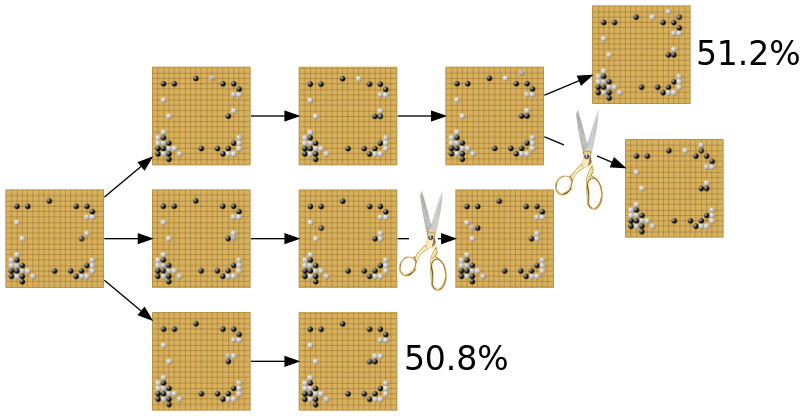
Trying to predict your opponent's behavior perfectly is impossible, because we aren't mind readers. But a strong Go player does not really try to predict human behavior. It's the game itself that is hard to predict. During reading, you can hardly ever follow a variation to the end of the game and instead have to cut your reading short to save time. The value of the unfinished game position reached that way is very often guessed. That guess uses exact measure like number of liberties and number of eyes, but also hard to quantify concepts like territory, influence, strength, weakness and so on. Not even professionals can agree on the evaluation of all Go positions, otherwise there would be no progress in Go research.
What is it in our decisions that is random or has to be modeled as random? One thing we don't know is our opponent's plan. Without knowing that plan, we would have to guess it and that guess could be wrong. Not knowing the opponent's move at all doesn't work - you have to take your opponent's reaction into account to figure out which of your moves is best. But not being mind readers is actually not the real source of randomness. When playing strongly, we usually just place ourselves in the opponent's shoes and assume the opponent would play the same moves we would play. If both players are equally strong and don't really make mistakes, that assumption is pretty good. But of course we do make mistakes. The problem is not really being unable to predict our opponent's behavior, but to predict a strong player's behavior in general, including our own. Yes, we can't even predict our own behavior. At some point in time, you certainly have played a move and immediately afterwards thought "That was so stupid". Had you had that realization before playing the move, you would have decided differently.
But a strong Go player does not really try to predict human behavior. The player tries to predict the game itself. And unfortunately, irrespective of Go being a non-random finite two-player game with perfect information , it is just too complex to model completely in your mind or even to memorize completely. To be able to come to any decision at all, we must take mental shortcuts. There are two obvious shortcuts: First, we don't actually consider all legal moves, but rather consider only a small selection of candidate moves based on our intuition, i.e. experience. Second, we rarely follow all variations to the end of the game and instead stop way short of it at an unfinished position that we then evaluate, once again based on our experience. Part of that evaluation uses relatively exact measures like the number of liberties and number of eyes, but to get a complete evaluation, we also have to count territory, influence, strength, weakness and so on. That is not an exact science, not even in the heads of the strongest professional players. Professionals might agree on the evaluation of most positions, but they definitely disagree on some of them. Otherwise there would be no progress in the study of Go. For example, decades ago an early 3-3 invasion under a 4-4 stone was considered disadvantageous for the invader, but it's considered playable now.
Apart from these shortcuts, there are also honest mistakes, especially under time pressure. These mistakes lead to a lower quality of play, which is measurable in a broader probability distribution of outcomes. Mistakes aren't completely independent, of course. Making one mistake can provoke more mistakes in the near future.
Apart from these shortcuts, there are also honest mistakes. Most humans, even profesional Go players, just aren't capable of applying all their Go knowledge consistently all the time. That is especially true under time pressure and more generally stress. In fact all our mental activity suffers from more mistakes under those conditions, not just playing Go. The result is that under time pressure and other stressors, our additional mistakes lead to a lower quality of play, which is measurable in a broader probability distribution of outcomes. That means that under slow time settings a strong player might be able to turn a 5-point lead in the endgame into a win 99% of the time, but would only achieve maybe an 80% winrate in the same position when blitzing.
These mistakes can't be modeled as completely random and independent, of course. It is well known that humans tend to follow mistakes by making even more mistakes, possibly emotionally shaken by the first mistake or being possessed by a consistently wrong idea (e.g. believing a dead group to be able to live, or believing a certain invasion to be a good idea) or changing the plan (from "playing safe to secure a small lead" to "playing aggressively to catch up") after making the first mistake.
Could our decision making be modeled as deterministic in principle? Quantum effects could influence the brain, and those could be actually random . The brain might also filter out all random noise to protect itself from its influence, like semiconductors chips are constructed to be nearly immune to the random effects influencing their individual atoms. Randomized algorithms and quantum algorithms like Shor's algorithm can be much more efficient than deterministic algorithms, so maybe the brain evolved to make use of randomness.
But could our decision making be modeled as deterministic in principle, if we had all the tools to measure neural currents exactly? There are people who say that quantum effects play an important role in neural processes, which would make them partially random due to the random nature of quantum theory . I do not necessarily agree, but it's clear that not everyone is convinced yet that our decisions are free from randomness. We could even delve into the discussion about free will, but that would lead too far now. One reason to not agree with the supposed quantum influence is that our mental processes are an emergent behavior of the collaboration of many neural cells and that for the sake of stability of these processes it is advantageous to filter out all random influences using redundancy (e.g. adding the output of many neurons together instead of relying on just one neuron) . We do the same in semiconductors. Behavior of individual transistors is partially random, but we build in sufficient safety margins for those random effects to not influence the behavior of the whole chip. We want the entire chip to behave deterministically and consider a breakdown in that behavior to be a failure state. In fact such a breakdown quite often results in a crash of the entire system. Only recently have true random generators been included in the chip design for the purposes of cryptography. Before that, semiconductor chips were incapable of truly random behavior, they could at best produce pseudo random numbers.
A human brain is not a semiconductor, so maybe deterministic behavior wasn't a "design consideration" (yes yes, the human brain is the result of evolution, don't get your jimmies rustled) . There is strong evidence that randomness in algorithm design can have potentially gigantic advantages in some limited cases, allowing problems to be solved algorithmically in many cases where an exact solution by a deterministic algorithm would be prohibitively expensive. And in quantum computing there are algorithms like Shor's algorithm that require non-deterministic behavior to be efficient. So maybe having access to true randomness does offer an advantage. If that advantage is large enough, our brains might have evolved to make use of it. If that is the case, we should eventually be able to measure it in the laboratory, potentially using functional MRT or using tiny model organisms like fruit flies.
Even modern Go AIs use randomness in the form of stochastic gradient descent during artificial neural network training and defeat all humans, while classical deterministic AIs failed to do that. Coincidentally ANN (artificial neural network)s are modeled after the human brain, not after deterministic semiconductor computers. My previous article argues that strong Go AIs actually can't avoid guessing and so a superhuman, completely deterministic Go AI may never be possible. The randomized modeling of the game in modern Go AIs is visible in the statements they make: Always percentages, never a definite statement like a Chess AI would make in the late endgame.
The conclusion is that Go is deterministic only in theory, but unpredictable like a game of chance in practice.
If computers are deterministic, then there should be no reason for AIs to use randomness, right? Not so fast. AIs can be made to be deterministic and that can be useful for reproducing previous results exactly, but just as randomness can be useful for algorithm design in general, it can also be useful for board game AIs. Strong modern Go AIs like Katago use trained artificial neural networks as part of their design and these neural networks are trained using a randomized algorithm similar to stochastic gradient descent. One could use non-stochastic gradient descent, but that is much less efficient. The random numbers consumed by stochastic gradient descent do not have to be truly random, they can be pseudo random numbers, but once again for practical purpose it doesn't make a difference. The exact behavior of a trained ANN (artificial neural network) doesn't become more predictable or easier to understand just because pseudo random number were used during training.
And coincidentally, ANN (artificial neural network)s were designed to mimic the general behavior of naturally occurring neural networks like our brain. Earlier Go AIs that didn't use ANN (artificial neural network)s and worked completely deterministically weren't able to beat the strongest humans, but ANN (artificial neural network)-supported AIs using Monte Carlo Tree Search can do that. It may really be a coincidence, but it's fascinating that AIs modeled after our squishy imprecise brains are better at Go than AIs that adhere much closer to the deterministic concept of a computer. Can AIs in principle avoid randomness completely and still remain as strong as they are? I don't think so, because AIs have to take the same shortcuts as humans: following candidate moves along shortened variations and then guess the outcome at the end of each variation. Read here if you want to know why I think these guesses will always remain guesses. The result is that even the strongest AIs only predict probability distributions (like "80% winning probability") , not definite statements (like "the game is won") . That is in contrast to Chess, where at least in some endgame positions, exact statements about the outcome are possible. In Go the same is true in principle, but it's very impractical in reality even for 9x9 boards. The statements of Katago may seem definite (e.g. "100% winning probability") , but that is usually a rounding artifact and can not be used as part of a mathematical proof. Statements in Chess endgame tablebases are definite and have the quality of a mathematical proof.

So next time someone tells you that there is no randomness in Go, you can smugly say "Well, akchyually ..."
Click here to send an edit suggestion
Written by the author; Date 05.03.2026; © 2026 spinningsphinx.com
- Mocking
- Sarcasm, e.g. "Homeopathy fans are a really well-educated bunch"
- Statement not to be taken literally, e.g. "There is a trillion reasons not to go there"
- Non-serious/joking statement, e.g. "I'm a meat popsicle"
- Personal opinion, e.g. "I think Alex Jones is an asshole"
- Personal taste, e.g. "I like Star Trek"
- If I remember correctly
- Hypothesis/hypothetical speech, e.g. "Assuming homo oeconomicus, advertisement doesn't work"
- Unsure, e.g. "The universe might be infinite"
- 2 or more synonyms (i.e. not alternatives), e.g. "aubergine or eggplant"
- 2 or more alternatives (i.e. not synonyms), e.g. "left or right"
- A proper name, e.g. "Rome"